Friday, June 23, 2017

Greensboro Hotel


In the summer of 1936, when James Agee and Walker Evans were working with the tenant farmers, Agee would sleep in one of the tenant houses. Walker Evans didn't like that, he would rather stay at the hotel in Greensboro.
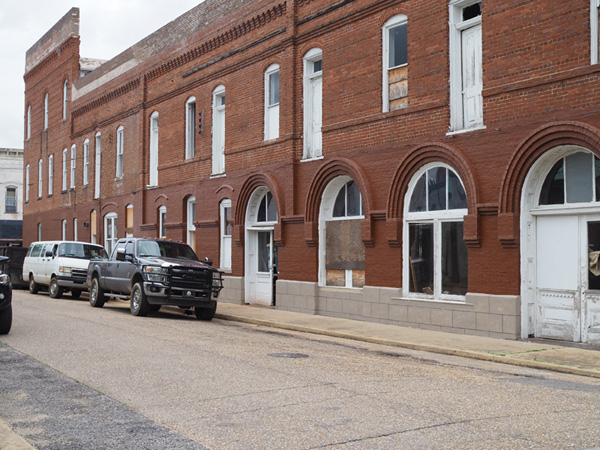


I have no idea when it was built but I found an old picture online, showing that the structure had an elaborate balcony structure not only on the side facing main street but also running down the side along Market Street.

http://genealogytrails.com/


When Walker Evans was staying at the hotel, he took two pictures of Main Street, most likely from the balcony on the second floor. One to the East in the direction of the courthouse:

Walker Evans: Greensboro, Alabama. Main street buildings and county
courthouse cupola, courtesy loc.gov


Most of the buildings on this picture are still there today.

And one to the West:

Walker Evans: County seat of Hale County, Alabama, courtesy: loc.gov
It took me a while to find out which buildings I see on this picture: It was the use of a long telephoto lens that is confusing. The balcony on the left side of the picture belongs to the Greensboro Opera House (the brick building on the very right on my picture below). Therefore Evans must have stood way on the left corner of the hotel's balcony to photograph this picture.

Today the Greensboro Hotel is not a hotel anymore. After closing down as a hotel the building hosted a sewing factory as well as church congregations before it was left to become quite ruinous.

A while ago the building was purchased by a donor and given to the charity organization of Project Horseshoe Farm which is offering multiple programs to strengthen the community. 

The ground floor is almost finished, therefore the move from another structure on Main Street is about to happen soon. 

 
The second floor is already being worked on, and the third floor, which will offer housing to volunteers and fellows, will still need some time to be finished.


Thursday, June 22, 2017

Camellia Court


Camellia Court is again one of the old antebellum structures in Greensboro, Alabama. I am very happy that this will be my home for three weeks and that I will inhabit the entire house by myself. Camellia Court was built around 1835 and has been renovated to comprise open spaces on both floors. Only the bathrooms have doors.


Camellia Court is named after  what was to become the Alabama state flower in 1959, Camellia japonica, a plant introduced to Alabama from Asia. I think it was part of 19th century exoticism that people would plant this in their yards. As a state flower the camellia dethroned the local goldenrod as – according to the narrative – the state deserved something more refined than this ubiquitous wild flower. Of course there are camellias in the garden, but as they are also called the rose of winter I found only a few withered blossoms.

the side of the house


the front porch


The house is hiding behind bushes and big trees from the street, thus it feels really remote, even though it is situated just behind the court house one block off of Main Street. From the front windows I can see my last residence, the Poellnitz-Vick House.


The two story house has an open kitchen and living room downstairs and a bedroom, desk, and sofa plus TV screen upstairs. As always I like to sit in the kitchen, thus slowly I have been moving most of my work downstairs.


The kitchen has a large door and a small porch facing the garden. Just now the door is open and I hear the rain (tropical storm Cindy is sending epic masses of water from the Caribbean pouring down on Alabama) but also the crickets which tend to be really loud at the time of sunset.


Pam, the owner, has left a few walls in the old state, which adds a nice vintage feel. And the old wooden floor is just amazing.


Something that one may find odd at the beginning is taking a shower with a free view on the garden. But as there are thick greens barring the view to the next door neighbors this is a nice way to start the day.


Wednesday, June 21, 2017

Whitney Plantation


Whitney Plantation – originally known as Habitation Haydel – is a former plantation on the Mississippi River about a one hour drive west of New Orleans. This part of the Mississippi is called the "German Coast" as many settlers from Germany came here to grow food to begin with and later sugar cane as the major cash crop of Southern Louisiana during the 19th century.


There are plenty of old plantation homes that are open to the public that tell about plantation life and history during the 18th and 19th centuries. However, many plantation tours only briefly mention slavery and may point to some small cabins adjacent to the splendid big house before indulging once more in the wonderful Southern lifestyle back in the days.


Whitney Plantation features a different approach: They do a lot of research on the institution of slavery which is not only featured in a small exhibition on site. The guided tour is led from the perspective of slaves. As there are not that many remnants of former slaves left as history is usually told from the perspective of the slave owners and their houses and belongings, artwork is used for remembrance of the sufferings of the slaves.


There are walls of remembrance with names and as much information as possible of individuals brought to Louisiana from the Senegambia region of Africa. Some spaces also access the narratives of former slaves that were conducted by the Federal Writers' Project. Parallel to the Farm Security Administration, that hired photographers to document the plight of farmers during the Great Depression, the Works Progress Administration hired writers and anthropologists to give them jobs. As there were still people alive who were born into slavery the FWP conducted many interviews throughout the South gaining precious first hand accounts of formerly enslaved African Americans. Alan Lomax, who at the time was archiving the American folk song traditions, drafted a questionnaire used in this research.


Distributed throughout the site are sculptures by Woodrow Nash, mainly life-size sculptures of enslaved children.


Some of the slave cabins are original to the Haydel Plantation but were moved closer to the house. Most of the cabins were demolished in the 1970s, but now the Whitney Plantation buys such structures from other former plantations in the area.


The prison was found someplace else, but plantations often would use prisons like this to discipline slaves who had tried to run away or did not behave according to the expectations of the slave holders.


Not included in the tour – because visitors felt offended – is the memorial to the initiators of the so called 1811 German Coast Uprising, the largest slave revolt in US history. Slaves from different plantations marched towards New Orleans to gain freedom. Eventually they were defeated and the organizers beheaded. Their heads were displayed on poles along the river to discourage future upheavals.


Mobile II


Being located at the mouth of the Mobile River Mobile has a large port which can be seen from downtown. It is Alabama's only saltwater port. Comparable to other US cities the access to the waterside is impaired by a huge street that has to be crossed. There is a little park on the water, though, where it is possible to smell the sea as well as the diesel fumes from the big vessels.


Apart from the very small downtown section that holds some shops and many bars and restaurants I encountered many buildings for sale or boarded up.


One building that stood out is the Grand Lodge of Alabama. I have encountered quite a few buildings hosting freemason's societies throughout the south, but I have never come across one this spectacular.


Also, for my taste there was just too much space for parking thus sprawling the downtown section in a way that is a very familiar sight in many US cities.


On a Friday afternoon the city was very quiet, however, it seems that there are not only block parties to be celebrated, but also some problems with cruising and noise.


the sign reads: nose ordinance enforced


And I still have to find out about the "Cheerful Credit".


I hope this makes you enjoy your furniture more and not sit on it and cry because of high interest rates...