Friday, July 07, 2017

The Greensboro Watchman


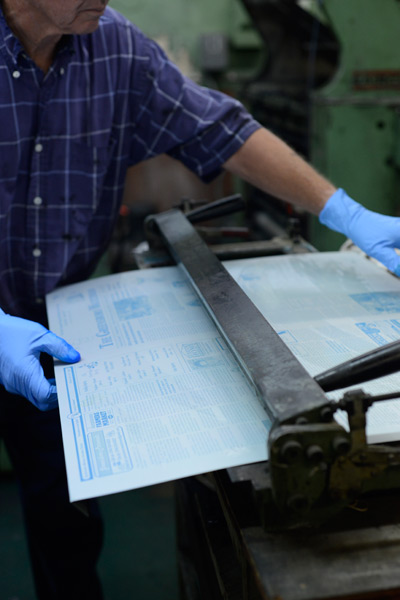
The Greensboro Watchman is the local newspaper that is published weekly since 1876. Today it reports news from the community, presents people and places and gives room to obituaries.


The paper is printed on an old reel-fed offset printing machine situated directly behind the office.


In the back room of the office one can find yearly volumes with all the issues back to the newspaper's beginnings. Unfortunately these are kept in an non-archival environment.


I had the chance to look into the book of the year 1936 because I was curious if anything was reported on the presence of Walker Evans and James Agee in Hale County. By just leafing through quickly I didn't find anything. But maybe they were mentioned in the people's section. It would need a more thorough research to find that out.


In the 1930s, however, The Greensboro Watchman not only reported local news but also national and international events, even though especially the ongoing drought in Hale County was a big issue.

I am not sure if I had made it to the front page back in the days.


Wednesday, July 05, 2017

Dear Mr. Evans,


As my time in Greensboro is running out, I have to admit, I did search for some of the locations where you took some of your photographs. As I always liked the picture of the gas station/post ofice in Sprott, Alabama, I decided to drive there last Sunday. Sprott is situated in neighboring Perry County.

Walker Evans: Crossroads store, Sprott, Alabama,
1935 or 1936, courtesy loc.gov


Today it is basically a crossroads and nothing else. The old building is not there anymore and the one that took its place is closed. Across the street there are some old barns falling apart. There is nothing that could be defined as a town, no post office or anything else except for roads. When I kept driving, Google suggested to take a street that is basically inexistent, overgrown with shrubbery.


I have no idea what happened to the church that William Christenberry photographed and constructed as a sculpture, as it seems to be nothing there. I checked some satellite pictures and found a church that from above looks more like a barn than like the nice old structure with the two spires.

Walker Evans: Grocery store. Greensboro, Alabama, 1936, courtesy loc.gov


Another picture I really like is the one of the McCollum Grocery on Main St at the corner of Beaacon St. The building has seen some changes – back in 1936 there were two stores in this building and today the corner has been remodeled. The building is unoccupied at the moment. The street light is still at the same spot, though.

I have tried to find out when the balconies on various buildings on Main Street were taken down, but so far nobody was able to answer that question. It must have been some time between 1936 and the early to mid-fifties.

Walker Evans: Untitled photo, possibly related to:
Boardinghouse, Alabama, 1936, courtesy loc.gov


It is not easy to restore old buildings like this, but there are people who try to do whatever needs to be done. The building on the right is the Greensboro Hotel.

I also tried to find out, if the cotton gin in Moundville still exists. Yesterday someone told me it was still there and gave me directions. Checking the satellite images I did find the old depot (in the background), but the structure of the gin has completely been removed. As the area looks completely fenced in I consider it useless to go there to see for myself.

Walker Evans: Untitled photo, possibly related to:
At the cotton gin. Cotton gin and wagons.
Hale County, Alabama, 1936, courtesy loc.gov

Wildlife II


Unfortunately it is much harder to catch the beautiful animals than insects that I encounter, but I do have a nice assortment of newly photographed creatures to offer. Yesterday I also photographed a hummingbird that was at a feeder of a house I visited.


Finally I was able to catch – not only one of these beetles in a glass – but also on camera. It may be a Hardwood Borer Beetle, but I am not sure. They can be very big (this is not the biggest one I saw) and they can also fly. Mostly they run and I try to teach them, that it is not nice to be indoors. I hope, they tell the story to their friends. This one is walking the streets of Selma.


I encountered this Eastern-Eyed Click Beetle on my second visit to Perry Lakes Park. It is sitting on a shady bench – after the river left a muddy mess and completely buried the bank's legs with fresh sand.


Also in Perry Lakes Park, but n many other spots as well the Forest Tent Caterpillar Moth seems to be qutie active. They spin large tents around trees' branches and leaves which look amazing. I read that the y are not killing the entire tree but that they may defoliate and kill some branches.


And there is another bird I am having fun with at my house. Of course, you can only barely see the bird in the picture that is nesting in the lamp of my side porch. They tried to buld a nest in the lamp of my backporch, but as I always have the door open when home, I suspect I disturbed them by walking around indoors and on the porch.


So they decided to use the front porch lamp. One of them is always sitting in there, but as soon as I come closer, they fly off. They may be Pine Siskins, but I am not sure. The other day I felt bad because I needed to leave the light on, otherwise it will be hard to open the door when it's dark.

ADDENDUM: Today I had my first encounter with a rattlesnake. It was spread out across the path. I was scared and glad to be with someone who knows what to do.


Sunday, July 02, 2017

Rural Studio II


In downtown Newbern it is impossible to to notice the presence of the Rural Studio. Not only is the old warehouse used as a classroom building, but the Rural Studio also built a townhall, a fire station, and created a public library out of the old bank building – that looked like a bank out of a Bonnie and Clyde movie when I saw it for the first time four years ago.


The library  is a nice building that has some nice corners with cushions for secluded reading. But it also provides a visual connection to the famous green barn in its immediate vicinity. And it kept the old door of the vault.


The firehouse is home to Newberns voluntary fire department. It is situated across the street from the warehouse and adjacent to the Newbern Townhall.


A little behind the classroom building one can find a small memorial chapel in the garden: Subrosa Pantheon. It was originally conceived by Samual Mockbee as a memorial to mourning friends. However, he was not able to build it in his lifetime. I was eventually built by his daughter, who had no architecture training or building experience. However, she finished the task and it became a memorial to her deceased father.


Rural Studio I


The Rural Studio is an undergraduate program of Auburn University that was founded by Samuel Mockbee (1944–2001) in 1993. Participating architecture students not only design but also build homes that cost no more than 20,000 $ (the 20K Houses) and community buildings like town halls, libraries, sports fields, and the like. The Rural Studio was established in Hale County not only because Samuel Mockbee was familiar with Walker Evans's work there but also because he fell in love with its beautiful landscape. The headquarters are situated in Newbern, a small town 10 miles southeast of Greensboro. Some of the classrooms are located in the well known building photographed by William Christenberry.


Mockbee thought that architecture should not only serve people of wealth who are able to afford to commission an architect for their projects and urban communities. He was convinced that architecture – and architects – should show social and civic engagement and also serve rural communities.


Thus the students not only deal with designing, planning, and construction but also reach out into the communities, attend city council meetings, meet with local organizations, talk with potential clients to find out about their needs and meet with the people of the community.


Another idea is that of sustainability. Some projects implement existing structure, trying to save as much of the existing material as possible. Built in appliances and heating/cooling systems are energy saving and structural measures are used to save as much energy as possible. Private homes are often donated therefore it is important that the residents are able to afford living in them.


In the beginning the houses constructed often looked very special. They used a lot of donated or recycled materials such as car windshields, auto tires, worn down road signs, or even hay bales. In recent years designs seem to be less extraordinary but still special and they clearly stand out from the usual architecture. However, they will refer to traditional styles of construction in the South and/or use materials that are commonly used in this area.


I was able to get a guided tour by one of the Rural Studio's staff along some of the structures that have been built in the past almost 25 years. However, the private homes are often located in remote areas and their inhabitants need to guard their private sphere, therefore there are no tours that include them. However, by driving through the area I have discovered more buildings as there are quite a few.